



Daphne du Maurier speaks in a special broadcast to Canada – March 1941
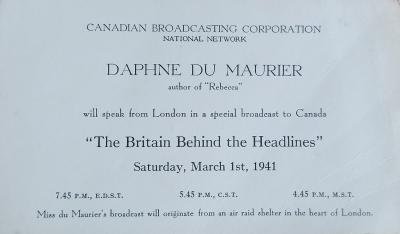
The scarce piece of du Maurier-related ephemera that we have just received at the Daphne du Maurier website
Much has been written about Daphne du Maurier in the years since she died in 1989. She is one of the few women writers of her generation who is still highly regarded and whose writing thrives. With virtually all her canon of work in print, some superb biographies, and regular references to her in newspapers, journals, magazines, and the media, as well as adaptations of her work in the theatre and on TV and radio, we feel a close link to her despite almost forty years having passed since her death.
Very often what is written about Daphne relates to Rebecca, her most famous novel by far and one that has never been out of print since it was published in 1938. Her other Cornish novels and short stories and the life she made for herself and her family in Cornwall are also much discussed.
It is rare, however, for something about which we know very little to put in an appearance, but that is exactly what has happened this month.
At the beginning of July we were contacted by the Constantine Museum and Archive. The village of Constantine borders the Helford River in the south and extends north to include the granite outcrops which gave rise to quarrying, which was at its peak from the mid-1800s to the 1920s. Many of the houses in Fore Street were occupied by granite workers in the early 1900s.
It was Alan Pearce, a volunteer at the museum, who contacted us because, while sorting out their archive, he had discovered a small piece of ephemera that was not relevant to their collection, as they only concentrate on information and history from their local area. In fact, one cannot imagine how it found its way into the Constantine Museum and Archive in the first place.
This piece of ephemera is a small card, measuring only 14cm x 8cm, but it provides us with such interesting information that we wanted to share it with you.
As you can see from the image, the card tells us that Daphne du Maurier would be speaking from London in a special broadcast to Canada on the subject of 'The Britain Behind the Headlines' on Saturday 1st March 1941 at 7.45 pm E.D.S.T. (Eastern Daylight Savings Time), 5.45 pm C.S.T. (Central Standard Time), 4.45 pm M.S.T. (Mountain Standard Time), and that the broadcast would originate from an air raid shelter in the heart of London.
This is quite remarkable when you consider how seldom Daphne du Maurier allowed herself to be involved in public-speaking events. Throughout her career, she took part in only a handful of radio and television programmes, so this particular event must have felt very important to her.
On the face of it, the idea that Daphne should broadcast to the people of Canada during the Second World War, from an air raid shelter in the heart of London, is extraordinary. It is possible that she agreed to do this because it was linked to her book Come Wind, Come Weather, which was first published in the UK in 1940 and then produced in editions for distribution in other countries, including India, the US and Canada.
Come Wind, Come Weather was a very special little book containing factual morale-boosting short stories, and was intended to give courage and positivity during the long years of WW2. The books were sold very cheaply, with the UK copies selling for sixpence and Daphne donating all her royalties from the book sales to the Soldiers', Sailors', and Airmen's Families Association.
We wrote an article about Come Wind, Come Weather in August 2023, and if you would like to find out more about the book and what was behind it being written, you can read it here: https://www.dumaurier.org/menu_page.php?id=218.
There are a couple of reasons why I think there must be a link between the Canadian edition of Come Wind, Come Weather and the talk that Daphne gave to the people of Canada. Firstly, the Canadian edition of the book was initially published in February 1941 with a print run of 50,000 copies, and a second impression was printed in March 1941, so only a month later, with a further print run of 50,000 copies. There was clearly a thirst for this small yet important book. Also, in the Canadian edition was a preface written by Daphne in January 1941, and this is what she said:
A Word to Canada
This book of true stories was written for the people of Britain in the hope that it would bring courage and strength to them in a time of crisis. The book was published on 15th August, 1940, the famous date of threatened invasion when every man, woman and child in the Kingdom stood waiting tense and expectant for the blow to fall. Since then we in this island have experienced the full horrors of war in the air. Many have faced death itself, others are homeless – parents without children, children without parents.
In spite of these things we are standing firm. We are not dismayed. The spirit of the British people is rising triumphant. The old lazy go-as-you-please, every-man-for-himself attitude is becoming a thing of the past, and out of this testing time of tribulation we shall arise, please God, worthy descendants of those ancestors of ours who first sailed the Seven Seas and laughed at danger.
You men and women of Canada are helping us in the European struggle. Many of your sons are with us now, showing great gallantry and courage in the face of danger, and their coming has strengthened even more, if it were possible, the link that binds our two countries together.
We believe that side by side with this war in Europe we are fighting another battle – the battle against human selfishness. We can only win the first if we are victorious in the second.
You people of Canada are fighting this battle too. We are allies in this war, just as we are allies in the war in Europe. Political differences, class struggle, financial wrangles, racial jealousies, these are all problems that must be solved before the new world can be born. Peace will not come nor unity be achieved among the nations of the world, unless we can first sow peace and unity ourselves. It is in the workshops, in the farms, in the factories, in the fields and above all in the homes that you men and women of Canada can lay the foundation stone. You have inherited a splendid past from your British and French ancestors; but you will bequeath a far greater future to your Canadian descendants, if you can hand down to them, side by side with equality and freedom, the new spirit of selflessness, co-operation and goodwill.
We speak of the British Commonwealth of Nations. There is a fine ring about this name that stirs our hearts and imagination. It means that we wish as countries to share our goods and our possessions, to carry the same burdens, to face the same dangers, to hold the same standards. As the Commonwealth of Nations, we march shoulder to shoulder in battle, and as the Commonwealth of Nations, we march shoulder to shoulder in this deeper struggle until the larger victory is finally won.
Daphne du Maurier
London, January 1941.
It seems most likely that the timing of the publication of Come Wind, Come Weather in Canada, and the amazing response to it prompted Daphne's broadcast. She clearly wanted to 'do her bit' for the war effort, and with Come Wind, Come Weather and her broadcast to the people of Canada, she went some way to achieving that.
We thank Alan Pearce and the Constantine Museum and Archive for seeking us out, so that they could find a good home for this small piece of ephemera that holds such important information. It now has a safe place in the du Maurier archive here.
Ann Willmore, July 2026.