



Daphne: The Secret Lives of Daphne du Maurier – a play written by Rosie Race
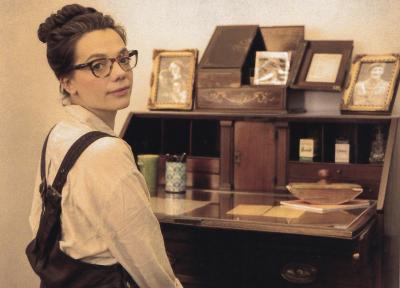
Rosie Race, sitting at Daphne du Maurier's desk, which is held at the University of Exeter's Special Collections Archive
Rosie Race is a playwright, actor and theatre maker, trained at RADA. Her new play, Daphne: The Secret Lives of Daphne du Maurier, was performed at the Northcott Theatre, Exeter at the beginning of July.
The play came about by a slightly unusual route. In August 2024, Exeter's Northcott and Barnfield Theatres launched Elevate, an artist development programme supporting local artists. At the same time, they announced their inaugural open script window, during which playwrights born or based in the South-West were invited to submit their plays. 109 entries were received, and 18 were selected for a range of development opportunities, including residencies, skills courses, and rehearsal readings. It became apparent from reading the plays that several South-West writers could create work at an exceptional level. So, early in 2025, a short list was drawn up of five exceptional playwrights, and they were all invited to pitch for a commission to write a new play to be performed on the Northcott stage. After long deliberation, it was agreed that Rosie Race would receive the commission from the Northcott Theatre to turn her pitch into a full-length script. Rosie's play was to be about Daphne du Maurier.
Throughout the rest of 2025 and into early 2026, Rosie worked on her play, conducting extensive research by delving into the Daphne du Maurier Special Collections Archive at the University of Exeter and by reading Daphne's works and the biographies other authors have published about her. By early 2026, Rosie had written her play, which has been described as an exciting, inventive take on one of the UK's great literary figures, and of course, one who spent much of her adult life in Cornwall.
Work on the play proceeded through the spring, with four actors taking on the many roles. The play was performed from 4-11 July 2026.
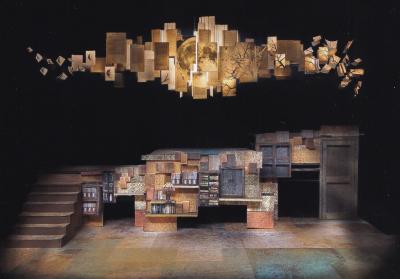
The set for the stage play Daphne: The Secret Lives of Daphne du Maurier, designed by Laura McEwen
The play begins with a scene shared by Daphne and her lawyer, drawing up an embargo locking away her most private journals and notebooks for 50 years after her death. In real life, it was, of course, her diaries that were embargoed for 50 years. This action sets Daphne's mind tumbling through moments in her life, and the play tumbles with her, beginning with her as a seven-year-old child at her home, Cannon Hall, with her father. The play then takes you through Daphne's life, from her youth to her eighties. It shows a life that defies the conventions expected of women of her generation, as it explores her relationships with those around her.
The main theme of the play is the relationship between Daphne and her father, Gerald, the famous actor-manager who was a leading light on the Edwardian stage. He was a complex man, and his love for Daphne, his middle child, was portrayed as boundless. During the play, the effect this relationship has on Daphne never eases, even after Gerald's death, and he continues to appear to her, haunting her throughout the rest of the play. Of course, this was the writer's interpretation, and we can only speculate on how deeply Daphne was really affected by Gerald's love for her, and how obsessed with Daphne Gerald really was. Our only information on this comes from Daphne and her sister, Angela, in their writing, and from how biographers have interpreted their words in books about Daphne and her sisters.
As the play traces Daphne's life, it becomes evident that Gerald's grip on her affects her relationships with her husband, Tommy, and with Ellen Doubleday and Gertrude Lawrence. Events that take place in the play include Tod's role in Daphne's life, Tommy's tour of duty to Egypt in the 1930s, life at Menabilly, the absence of Tommy during the war years and his return afterwards, the Rebecca plagiarism case in New York, the play September Tide, and the premiere of the film The Birds in London. So, an interesting span of Daphne's life. Sometimes events jumped around and happened out of sequence compared with Daphne's real life, but were the playwright's interpretation of events.
There was a cast of only four actors who, between them, played more than a dozen different roles. Emma Stansfield took the part of Daphne and was on stage for virtually the entire play, during which time she worked her way through a whole gamut of emotions and situations.
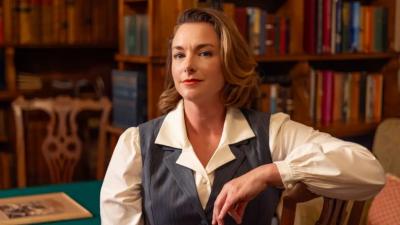
Emma Stansfield played the role of Daphne du Maurier
(Photograph by Lillie Sherry)
Daniella Bird was an unlikely, but very likeable Tod. Physically, she was not remotely as one would imagine Tod, who was at least twice the size of the actress, but she was portrayed very much as you imagine Tod's personality and devotion to Daphne to be. Danielle also took the parts of Ellen Doubleday, Gertrude Lawrence, a newspaper/media person and Kits as a child. She must have had quite some stamina to create all those characters, often in quick succession, with changes of accent and personality, and lots of different costumes.
Tristan Beint took on the roles of Tommy Browning, Nelson Doubleday, and Noël Coward, plus a couple of other minor roles, meaning he also played a range of parts with different accents, emotions, and personalities.
Lastly, William Mannering played Gerald du Maurier and Alfred Hitchcock, Gerald being the considerably more challenging role as he appeared throughout the play, mainly in highly charged, emotional scenes.
Was Daphne's life changed in the long term because of her somewhat strange relationship with her father? Of course, we don't know. This was the playwright's interpretation of Daphne's life. Does that matter? Almost certainly not, because for most of the audience this will have been an introduction to the life, or lives, of Daphne du Maurier. Their knowledge will mainly be about the books she wrote, some of which they will have read. For anyone more closely connected to Daphne du Maurier, it was perhaps not such an easy watch, but it is important to remember that this play was an artistic interpretation, not a factual piece.
Rosie Race, the cast and backstage creative team did a very good job of putting on such a complex play, and it will be interesting to see if it goes on to be shown more widely.
Ann Willmore, July 2026.