



The official Daphne du Maurier website, approved by her Estate
The 1939 Register and an entry for Daphne du Maurier
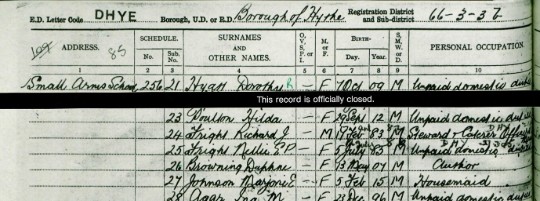
The entry for Daphne du Maurier in the 1939 Register, where she is listed by her married name, Daphne Browning
The 1939 Register, taken on 29th September 1939 and held by the National Archives, is an important historical document that provides a snapshot of the civilian population of England and Wales just after the outbreak of World War II. Although a survey of the civilian population, it shows members of the armed forces on leave and includes civilians on military bases.
The 1939 Register provided information used to produce identity cards and, once rationing was introduced in January 1940, to issue ration books. Information in the Register was also used to administer conscription and the direction of labour, and to monitor and control the movement of the population caused by military mobilisation and mass evacuation.
Registration of members of the armed forces was dealt with by the military authorities, so the 1939 Register does not include service personnel in military, naval and air force establishments. Nor does it include members of the armed forces billeted in private homes, including their own homes. However, since conscription did not begin in earnest until January 1940, most people who subsequently served in the armed forces during the Second World War were still civilians in September 1939.
Because the 1931 census was destroyed by fire and no census was taken in 1941 due to the war, the Register provides the most complete survey of the population between 1921 and 1951, making it an invaluable resource.
Interestingly, we have found the entry for Daphne du Maurier. She was married in 1932, so the entry shows her with her married name, Daphne Browning.
The entry shows that Daphne was listed as being at the Small Arms School, Hythe, where her husband, Frederick Browning, known as Tommy by his family and Boy by his colleagues, would have been working at the time. Daphne’s occupation is, of course, listed as Author.
Interestingly, only Daphne is listed and not her two daughters, Tessa and Flavia, who would have been six and two respectively. This may be because Daphne was only making a short visit and the children had remained with their Nanny. The Register should not be confused with the census, although, like a census, it tells us where people were at a specific moment in time.
Ann Willmore, July 2026.