



The official Daphne du Maurier website, approved by her Estate
How Cornwall Shaped the Imagination of Famous Writers – BBC News Article 14th February 2026
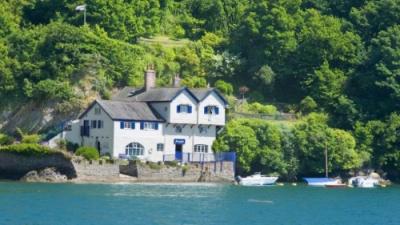
Ferryside
BBC Journalist Lisa Young has written an interesting article for the BBC News online this week. Called How Cornwall Shaped the Imagination of Famous Writers, she discusses Winston Graham, Virginia Woolf, Daphne du Maurier, E.V. Thompson, and his son Luke Thompson.
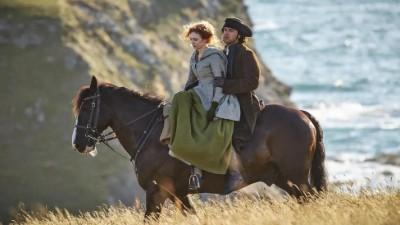
Winston Graham's Poldark
While researching the article, she spoke with Winston Graham's son, Andrew, about his father's wonderful series of twelve Poldark novels, which he began writing in 1945, returned to intermittently between his other writing, and concluded the saga in 2002, shortly before his death. Most people will remember that the Poldark series was adapted for two television series, bringing the wonderful Cornish landscape to our living rooms.
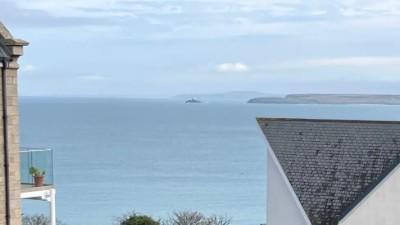
The view from Talland House across St Ives Bay to the Godrevy Lighthouse
Lisa describes the current concern and outrage, from local fans and across the world, because Talland House in St Ives, Virginia Woolf's (Virginia Stephen as she was then) family's holiday home, is set to have its view of the Godrevy Lighthouse blocked by a five-story development. Virginia was inspired by the view across St Ives Bay towards the lighthouse as a child, and it remained important to her throughout her life.
Emeritus professor Maggie Humm, vice chair of the Virginia Woolf Society of Great Britain, said that the view was absolutely central to Woolf, absolutely entwined. In the 1920s and 1930s, the view informed three of her novels – Jacob's Room, The Waves and To the Lighthouse.
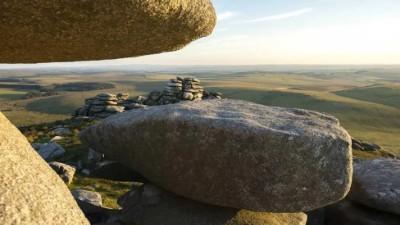
E.V. Thompson - An image from Bodmin Moor
When considering the writer E.V. Thompson, Lisa spoke to his son, Luke, who described how he came to write his first Cornwall-based novel, Chase the Wind. E.V. Thompson spent many years living in Cornwall, first in the village of Sharptor on Bodmin Moor, and later at the top of Mevagissey, where he had a writing room with views of the sea and the clay pits near St Austell. In his Cornwall-based novels, he was writing of things that he could see, and that were all around him.
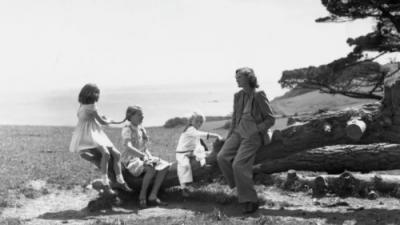
Daphne du Maurier and her children, c1940s
Having spoken with us here at the Daphne du Maurier website, Lisa wrote about how it was in Cornwall, and in particular the area around Fowey, that Daphne du Maurier discovered the freedom to write that, until then, had eluded her. Lisa writes that Fowey is featured in nearly all of Daphne's work, but of course, she means in her Cornwall-based novels, because she, like all the writers discussed in Lisa's article, produced a vast canon of work, some of which was not about Cornwall at all.
Lisa also describes how Daphne was a great observer of people and the landscape, and that she drew together what she saw and heard and built it into her writing. An excellent example of this is Daphne's first novel, The Loving Spirit (1932), in which she describes the natural world, the landscape and the weather, providing much detail about the area in which the story is set. Anyone living in Fowey or Polruan and reading this book can still totally identify with Daphne's writing, which is as accurate today as it was when it was written. This is one of the reasons Daphne's writing remains so relevant today.
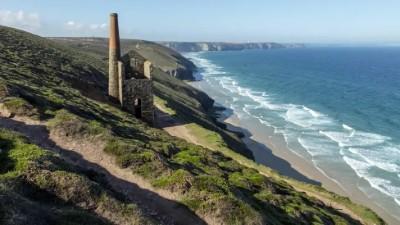
Luke Thompson - Cornwall
The article concludes with a reference to Luke Thompson's book Treasures of Cornwall and his belief that Cornwall continues to inspire creativity just as powerfully as it did for Winston Graham, Virginia Woolf, E.V. Thompson, and Daphne du Maurier.
To read the full article, please click here: https://www.bbc.co.uk/news/articles/c0lx9g0g62go.
February 2026.