



The official Daphne du Maurier website, approved by her Estate
Cornwall Uncharted by Paul Taylor-McCartney – A Book Recommendation
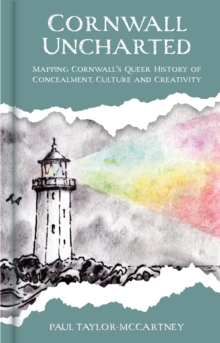
Cornwall Uncharted, or to give it its full title, Cornwall Uncharted: Mapping Cornwall's Queer History of Concealment, Culture and Creativity, written by Paul Taylor-McCartney and illustrated by James Innerdale, was published by The History Press last week, on 4th June.
Here is a quote from the book's foreword:
In the first book of its kind, 'Cornwall Uncharted' illustrates how our small Celtic nation is an agent in its own queer history; how its landscape and culture is not just a staging for its players but very much part of the story. Through his careful examination of archives, literature and landscape, Taylor-McCartney has crafted a book that explores the themes of concealment, culture and creativity throughout the centuries and into the modern day.
Following an introduction, the book is divided into six chapters that reveal the county's vibrant queer histories, tracing a hidden tapestry of creativity and community from the eighteenth century to the present day. Using art and literary analysis, examining paintings, poetry, novels, and private manuscripts, as well as archival records of coaching inns, market ledgers, architectural surveys, and wartime reminiscences, the author has reconstructed the social and cultural worlds in which nonconforming lives were forged.
The six chapters take us from urban concealments and coastal artist retreats to lighthouses, rural hinterlands, du Maurier's literary landscapes, and contemporary grassroots networks, demonstrating how Cornwall's unique geography has shaped queer expression and solidarity.
Challenging metropolitan-centric narratives, this book offers a compelling model of peripheral resistance and belonging, inviting scholars and general readers alike to rediscover Cornwall as a crucial site of queer innovation.
Here at the Daphne du Maurier website, we wanted to tell you about Cornwall Uncharted, which offers a sensitive new approach to its subject. Many performers, artists and writers are referred to in this book, including Samuel Foote, Oscar Wilde, Henry Scott Tuke, Violet Trefusis and A.L. Rowse, to name but a few. Virginia Woolf (1882 – 1941) and Daphne du Maurier (1907 – 1989) are also referenced. Both women were born and brought up in London, both had unconventional educations, both became hugely successful writers, and for both, Cornwall held a special place in their hearts.
Each chapter ends with a section titled Works of Note, which highlights writing linked to different areas of Cornwall and to the book's central theme. Examples include - The Friendly Young Ladies (1943) by Mary Renault – Truro, Bid Me To Live (A Madrigal) (1960) by HD (Hilda Doolittle) – Zennor, The King's General (1946) by Daphne du Maurier – Fowey, and Notes From an Exhibition (2007) by Patrick Gale – Penzance.
I have only two small criticisms of this book. Firstly, I always think a factual book should have an index, and this one doesn't; secondly, the footnotes are at the end of each page, which is excellent, but they could have been a little more detailed. For example, if a book is referenced, there is just the book title and the author, with no page number, which would refer us to the source of the information and be so helpful for people wanting to look at the references and find out a little more.
One of the things I particularly like about the book is that, as you read, you feel as if the author is sitting beside you, talking to you, which is a clever ploy in fiction but a stroke of genius in a factual book.
Ann Willmore, June 2026.