



The official Daphne du Maurier website, approved by her Estate
Wuthering Heights, the new film, and the Brontës influence on Daphne du Maurier
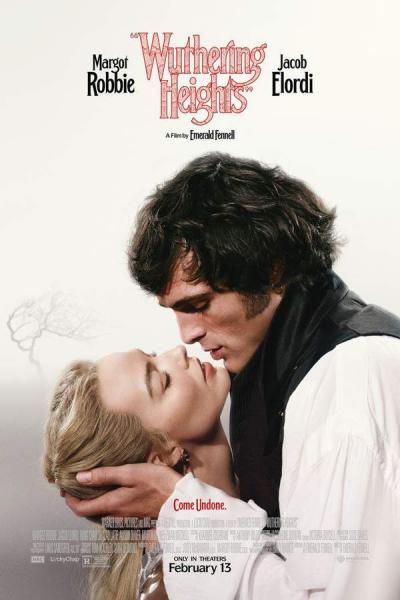
A poster for the film "Wuthering Heights", released in February 2026
On 13th February, a new film called "Wuthering Heights", starring Margot Robbie and Jacob Elordi, and written and directed by Emerald Fennell, was released in the UK and the US, following its world premiere on 28th January. The film, based on the 1847 novel of the same name by Emily Brontë, was released amid significant interest and controversy, much of which began before the general public had even had the opportunity to see the film and decide for themselves.
Wuthering Heights was the only novel that Emily Brontë wrote, and it was initially published under her pen name, Ellis Bell. Like the new film, which is causing quite a divide in how people are reacting to it, the novel had the same effect on its readers upon publication. With its story based on themes of love, possession, revenge and reconciliation, containing scenes of mental and physical abuse, including domestic abuse, it challenged Victorian morality, religion and the class system, making it an immensely controversial read. However, as time went by, views changed, and although it is still acknowledged as a grim and often brutal story, it is now considered to be a hugely important classic of English Literature.
Here on the Daphne du Maurier website, the new film has prompted us to reflect on the importance of the Brontës to Daphne du Maurier and the influence they, and particularly Emily, had on her writing. Daphne first read Wuthering Heights when she was twelve and returned repeatedly to the Brontë sisters' books throughout her life. Even towards the end of her life, when she was very frail and no longer able to write, the Brontës were very much in her thoughts. One of her nursing carers, a woman called Margaret Robertson, came from Yorkshire, and with her in particular, Daphne enjoyed talking about the Brontës and their writing.
Daphne always had a fascination for the Brontës' juvenilia, with their imaginary worlds of Gondal and Angria. Gondal even found its way into the du Maurier's own private language, becoming the verb 'to gondal', meaning 'to make believe' or 'to pretend'.
The Brontë sisters' work clearly influenced Daphne's writing, particularly some of her earlier novels, including The Loving Spirit, Jamaica Inn and Rebecca. The title of Daphne's first novel, The Loving Spirit, is named from a line in Emily Brontë's poem Self-Interrogation, and she began each of the four parts of the book with an extract from Emily Brontë's poetry.
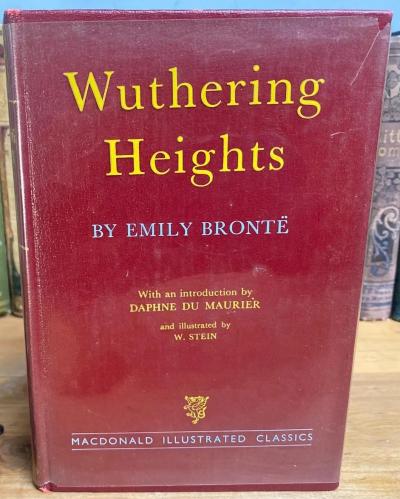
The front cover of the 1955 edition of Wuthering Heights by Emily Brontë, introduced by Daphne du Maurier
In 1954, Daphne was asked to write the Introduction to a new edition of Wuthering Heights, due to be published by Macdonald in London in 1955. She had never been to Haworth, and this gave her the opportunity to go there, to visit the Parsonage and to walk on the moor. She took her daughter, Flavia and her friend, Oriel Malet, with her. In 1954, Haworth was very different from how it is now. Although people did certainly visit the town because of the Brontë connection, there was not the rush of tourists there is now. In many ways, the town would have been similar to what it was like when the Brontës were alive. Oriel Malet described it as:
A dour, flinty village, but warm and friendly when seen from within. There were no souvenir shops, in fact, few shops of any kind, and the Parsonage, still a quiet and fairly secluded spot.
It was October and bitterly cold. The three women had hoped to stay at the Black Bull but were unable to, so they stayed in a small guesthouse nearby. Each day, after a substantial breakfast, they would walk to the Parsonage and spend many hours among the books and papers there. Daphne worked hard, enjoying every moment of her research. Each evening, after supper, they went for a walk, returning to the guesthouse through the churchyard. It was during this visit that Daphne developed an interest in Branwell, the much-overlooked brother of Charlotte, Emily and Anne.
During this first visit to Haworth, Daphne sent a postcard to her friend Foy Quiller-Couch, which we are fortunate enough to have in our archive. Because of its age, the image on the postcard is a black-and-white photograph of the Brontë Parsonage, standing as it does with the graveyard in front of it, which rather adds to the bleakness of the scene. However, on the reverse, there is a positive and uplifting message from Daphne to Foy, in which she says:
The Nursery window is the centre one. You can still see pencil drawing on the wall, and the letter-bricks for learning the alphabet, that were found under the floorboards, and a toy trumpet. Atmosphere so happy. Why will people pretend it was gloomy?
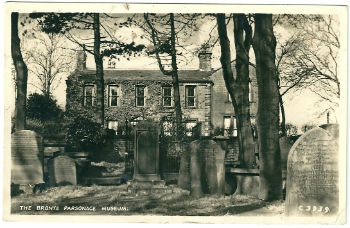
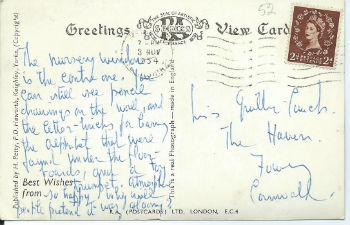
The postcard Daphne sent to Foy Quiller-Couch during her first visit to Haworth
Once Daphne had written her Introduction and sent it to her editor at Macdonald, she received a reply from him that delighted her. She wrote to Oriel and told her what he had said:
My editor of the Macdonald Classics has written so nicely about my Introduction that I sent him last week. He said he had read many books about Emily, and lots of essays, but he had never read anything before that gave him such a vivid and convincing impression of her work and personality, which was such a crumb for me, I thought! If you think for a moment, there was me, once, a silly young girl, just gloating on Emily and her book – and now I am an old writer myself, actually doing an Introduction on her great classic work – it is both noble, and humble-making, don't you agree?
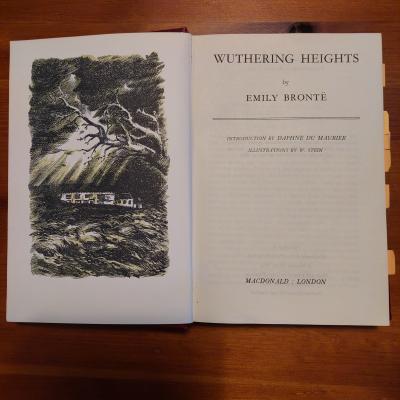
The title page of the 1955 edition of Wuthering Heights
Daphne's Introduction is an excellent piece of writing. But copies of the 1955 Macdonald edition of Wuthering Heights are now difficult to find, so opportunities to read her Introduction are also hard to come by.
We have transcribed it for you, and you can read Daphne's Introduction to Wuthering Heights here: Wuthering Heights DduM Introduction 1955
Thoughts of poor, overlooked Branwell Brontë continued to fill Daphne's head after her first visit to Haworth. However, Daphne was also approaching one of the most difficult periods of her own life. Her husband, Sir Frederick Browning, known as Boy to his colleagues and Tommy to family and friends, who worked at Buckingham Palace as Comptroller to the household of Prince Philip, had a nervous breakdown and was taken into a nursing home in London. He recovered gradually over many months but suffered from depression and exhaustion, and eventually retired, coming home to live permanently at Menabilly. Daphne had to use much of her energy looking after him and struggled not to break down herself, so she had to put aside thoughts of her writing.
Eventually, Daphne felt Tommy was well enough for her to resume her work, and the idea of writing a full biography of Branwell began to take shape. This was a major undertaking for Daphne, as she had never written a biography of anyone outside the family. She worked hard on her research, which included writing to J.A. Symington, one of the editors of the Shakespeare Head Brontë series, a comprehensive bibliography of the works of the Brontë family, including members of the family and their contemporaries, and other works on the Brontës.
Daphne and Symington corresponded extensively about Branwell and the broader Brontë family picture, and she found his information invaluable. She also made a second visit to Haworth, this time taking Tessa with her. Tessa was a tremendous help to Daphne on this trip, not least because she drove and took Daphne to numerous places, including Thorpe Green Place, Sowerby Bridge, and Luddenden, that Daphne felt she needed to get to grips with, so that she could envisage the Brontë family, particularly Branwell's, life. Daphne, with Tessa's help, researched many documents and manuscripts at the Brontë Parsonage, and this time she got to stay at the Black Bull, the inn that Branwell had frequented, and that had seen so much of his decline into drugs and alcohol.
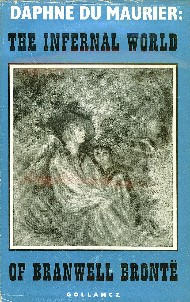
The Infernal World of Branwell Brontë, First edition, published 1960
Research went well, and the book began to take shape, but Daphne's biggest concern was that Winifred Gerin was also writing a biography of Branwell Brontë. Winifred has written an excellent biography of Anne Brontë, which alarmed Daphne, who had no real experience as a biographer beyond the books she had written about her own family. Good fortune prevailed, however, and Daphne's book, The Infernal World of Branwell Brontë, was published in 1960, eight months before Winifred Gerin's book.
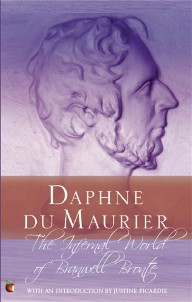
The Infernal World of Branwell Brontë, currently available paperback
Daphne's biography of Branwell was the least successful of all her books, as measured by the number of copies sold initially. This was almost certainly because it was such a deviation from the writing people expected her to produce, and the subject matter was not necessarily of major interest to vast numbers of people. But it was a good and thought-provoking biography, and Daphne was proud of what she had achieved in writing it. It is, of course, still in print today, published in paperback by Daphne's current publisher, Virago, and is definitely worth reading.
Throughout her writing career, Daphne wrote a number of essays and articles about the Brontë family, including the chapter entitled The Brontë Heritage in Vanishing Cornwall. This chapter focuses on Maria Branwell of Penzance, who married the Reverend Patrick Brontë. They were the parents of Charlotte, Branwell, Emily, and Anne (and two other daughters who died when young, Maria and Elizabeth). The children's mother died when the children were all very young, and her unmarried sister, Elizabeth, who was always referred to as Aunt Branwell, left Penzance and travelled to Yorkshire to run the household and care for Maria's family. The link the Brontë family had with Cornwall, through Maria and Elizabeth, was of great significance to Daphne.
Of all Daphne's writing about the Brontës, it is difficult to know whether the Introduction to the 1955 edition of Wuthering Heights or the biography of Branwell was the most important to her. With the biography, Daphne certainly produced an excellent and well-researched book that she could justifiably be very proud of. But I am inclined to think that the Introduction to the 1955 edition of Wuthering Heights, in which she wrote an introduction to the book that was more important to her than any other, is the piece of writing about which she was most proud.
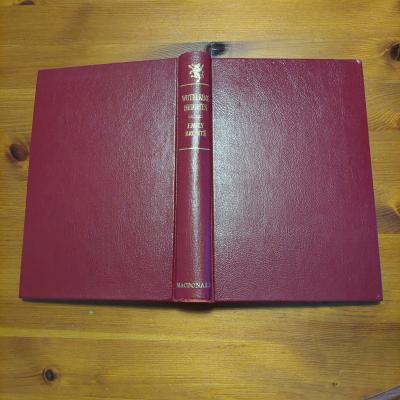
The open covers of the 1955 edition of Wuthering Heights by Emily Brontë, introduced by Daphne du Maurier
It has been a pleasure to look back at Daphne du Maurier's fascination with and love of the Brontës, and it is interesting to reflect on the important place they took in her life and in her writing career. So, we can thank the new film of "Wuthering Heights" for sending us off on this memory trail.
But what about the new film? Well, it was beautiful, and I loved it, and I could not stop thinking about it afterwards. What it wasn't, however, was a film of Emily Brontë's book!
© Ann Willmore, February 2026.